Historical Context
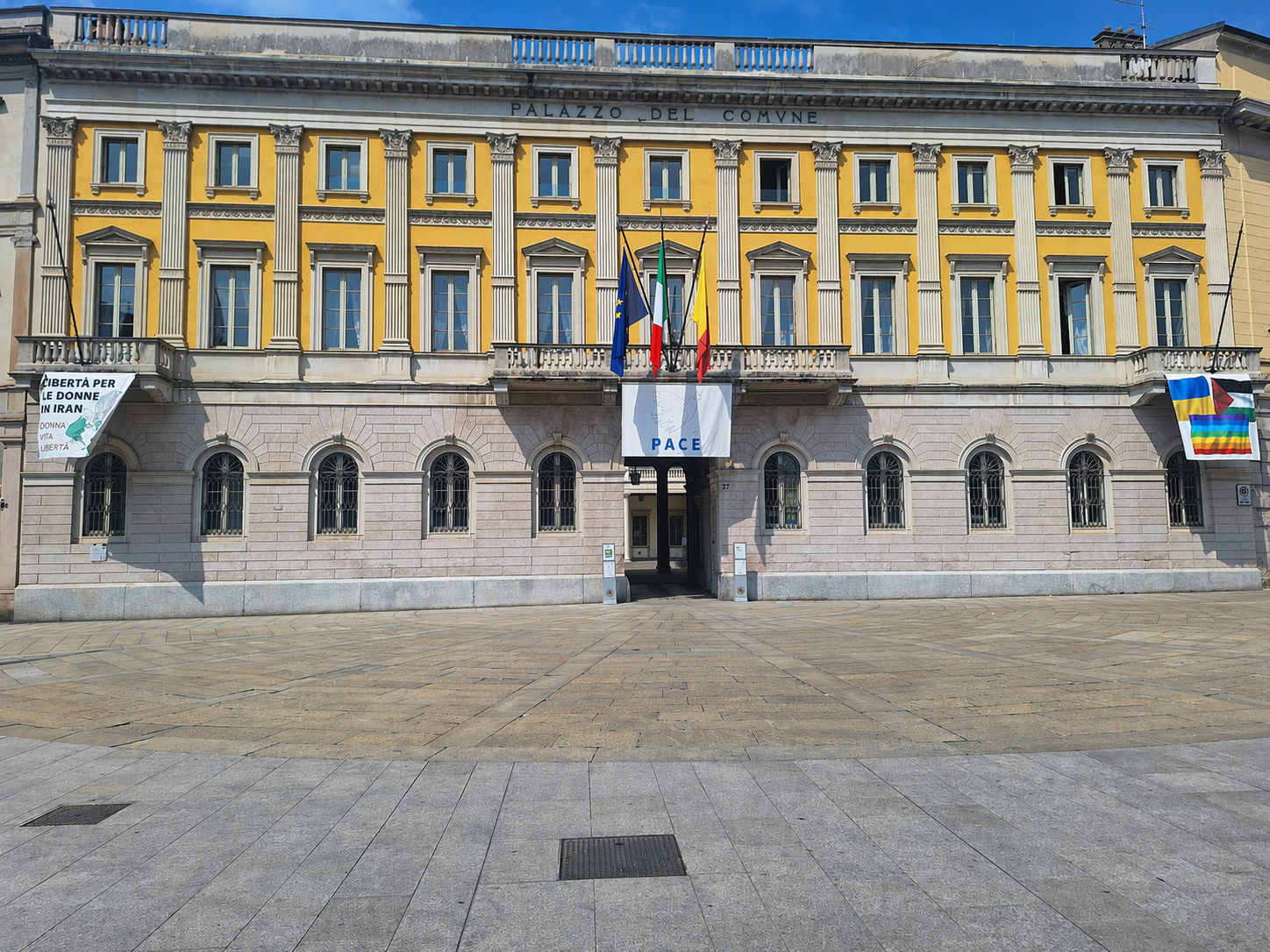
Reaching Piazza Giacomo Matteotti, we come across the City Hall building known as Palazzo Frizzoni.
This building, a symbol of municipal power, became the official seat of the local administration on October 28, 1928 (anniversary of the March on Rome ), replacing the old building located in Via T. Tasso, 4. The choice of this date was not random: October 28, 1928 marked the celebration of Mussolini’s rise to power and the fascist regime, representing a moment of consolidation of central government control over local administrations. Thus, Palazzo Frizzoni became the symbolic place of fascist power in the city. At the head of the municipal administration was the podestà, a figure who replaced the mayor, and one of the most well-known podestàs of that period was Antonio Locatelli, who held the office during those years.
🎧 Audio Reading
The March on Rome marked the beginning of the fascist regime and became an opportunity to legitimize the central government's control over local administrations.
Why it is a place of memory
From February 4, 1926, all the functions of the mayor, municipal council, and executive committee were centralized and assigned to the podestà, a figure inspired by medieval models of centralized government, appreciated by Mussolini, who reinterpreted them as tools of autocracy and control. This reform gave the podestà exclusive power to appoint and manage municipal offices, eliminating any form of popular participation.
The podestà remained in office for a period of 5 years, but a subsequent fascist law established that only married men could hold this position, which excluded Antonio Locatelli from continuing his mandate. This episode represents a clear example of the rigid and punitive regulations imposed by fascism, which established rules not only political but also social and personal, aiming at total control over private lives. Palazzo Frizzoni therefore stands as a witness to a time when local autonomy was replaced by fascist dictatorship.
🎧 Audio Reading
Multimedia Content
In-depth – Antonio Locatelli
Antonio Locatelli was born in 1895 and took part in the First World War as an aviator, distinguishing himself for his courage and piloting skills. The war experience deeply marked his life and strengthened his connection to nationalist ideology, which later led him to enthusiastically join fascism.
During the rise of the fascist regime, Locatelli began a political career: between 1924 and 1928 he was elected as a deputy to the Parliament of the Kingdom of Italy. In 1933 he started his activity in Bergamo, taking on the role of podestà. However, his position lasted only one year: in 1934, following a law introduced by Mussolini that prevented unmarried men from holding public office, Locatelli was forced to leave his role.
On January 7, 1936, he volunteered for the war in Ethiopia, participating in military operations as an airplane pilot. During the conflict, despite the technological and military superiority of the Italian army, Ethiopian forces managed to organize effective resistance actions. On a night in June 1936, Ethiopian forces attacked an Italian airfield, setting aircraft on fire: all the soldiers present were killed, including Antonio Locatelli.
His death was immediately celebrated by the regime as a heroic sacrifice. In Bergamo, a true cult of the hero developed, fueled by fascist propaganda, which presented Locatelli as a symbol of courage, dedication to the homeland, and loyalty to fascism. Even today, in the tower located in Piazza Vittorio Veneto, Antonio Locatelli is remembered through a sculpted portrait, a testimony to historical memory and the significance his figure had for the city.
"La rivista di Bergamo", a newspaper used for local propaganda during the dictatorship, dedicated its entire July–August 1936 issue to the memory of Antonio Locatelli pp. 367–413
🎧 Audio Reading
Sources
Bibliographic sources
- Mario Pelliccioli, Memory itineraries. A route in Bergamo through fascism, German occupation and Resistance, Moltefedi Achille Grandi Editore, Bergamo 2023
- Emma Coggiola, Humble and fragmentary pages of the Resistance in Bergamo, Stamperia Conti, Bergamo 1952.
- Marcella Cattaneo, Tosca Rossi, Bergamo sculpted: journeys through the history of Bergamo through the voices of its stones, Grafica & Arte, Bergamo 2018
- Patrizia Gabrielli, "A collective narrative of the civil war", in Italia contemporanea, Franco Angeli, Milan, n. 268-269, December 2012
- Historical Archive: Mai periodicals, Angelo Mai Civic Library Rivista di Bergamo
Multimedia sources
- Image 1: Project photographic archive, class 5IG Itis P. Paleocapa
- Video: Voices of memory: the story of Antonio Locatelli, Bergamo ANCR Federation