Historical Context
We are now in the heart of the lower city, a space that took on a central role in Bergamo’s urban development and public life throughout the 20th century. At the beginning of the century, based on a project by architect Marcello Piacentini, city life gradually began to shift from the upper city to the area where we are today.
The square acquired a strong symbolic and civic value, becoming the main place for celebrations, demonstrations, and public gatherings. Starting in 1921, it was officially named after Vittorio Veneto, taking on the meaning of a space dedicated to the memory of Bergamo’s fallen soldiers of the First World War and becoming an important place of collective memory.
🎧 Audio Reading
The square takes its name from the Battle of Vittorio Veneto (October 24 – November 4, 1918), which marked Italy’s final victory over the Austro-Hungarian Empire in the First World War. This event was considered decisive for the end of the conflict and became a symbol of sacrifice, heroism, and national unity.
Why it is a place of memory
On October 27, 1924, the day before the anniversary of the March on Rome, Benito Mussolini inaugurated the tower that still dominates the square today, transforming it into a true celebratory monument of the regime. During the event, in addition to the Duce, Antonio Locatelli and Giacomo Suardo also gave speeches, both key figures of local and national fascism. In 1936, following the defeat in East Africa, the names of eight fallen soldiers were engraved on the tower, including that of Locatelli, further strengthening the connection between the monument and the fascist rhetoric of sacrifice and heroism.
Giacomo Suardo was one of the leading figures of fascism in Bergamo. He served as the local secretary of the National Fascist Party and was also a member of parliament, acting as a link between local and national fascist power.
Inside the tower there is also a sculpted portrait in his honor
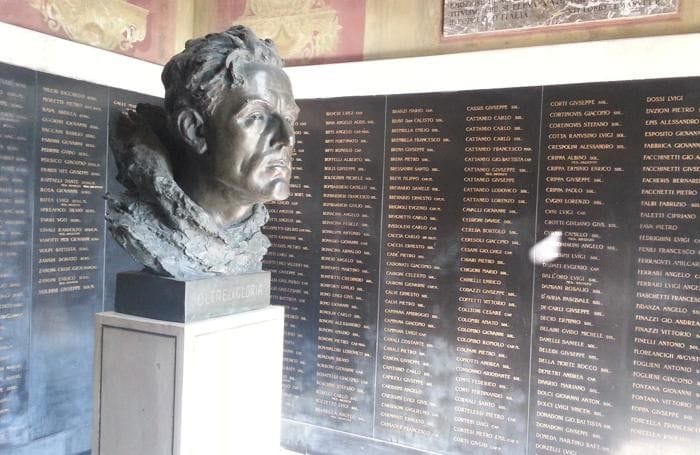
However, the meaning of the tower and the square changed over the years, especially after September 8, 1943. On July 25, 1943, following an antifascist liberation attempt, Ernesto Rossi, Luigi Bruno, and Mario Mammuccari spoke from the tower, symbolically marking a break with the past regime. On November 4, 1943, a group of women decided to express their opposition to the Nazi-fascists through a simple yet powerful symbolic gesture: laying and throwing flowers at the base of the tower. After the liberation between April 25 and 28, 1945, the partisan groups, instead of speaking from the tower balcony as the Duce had done, deliberately chose to set up a raised stage in the square, placing themselves almost at the same level as the people. This gesture emphasized the desire to break away from the regime’s authoritarian rhetoric and to establish a new relationship between citizens and power, based on participation and closeness. Even today, Piazza Vittorio Veneto remains a symbolic place for democratic demonstrations, including April 25 (Liberation Day) and November 4 (Armed Forces Day), which conclude in this very square.
An antifascist politician and intellectual, among the main founders of the Action Party; during the fascist regime he actively opposed Mussolini and, after September 8, 1943, took part in the Resistance and in promoting democratic values.
🎧 Audio Reading
Multimedia Content
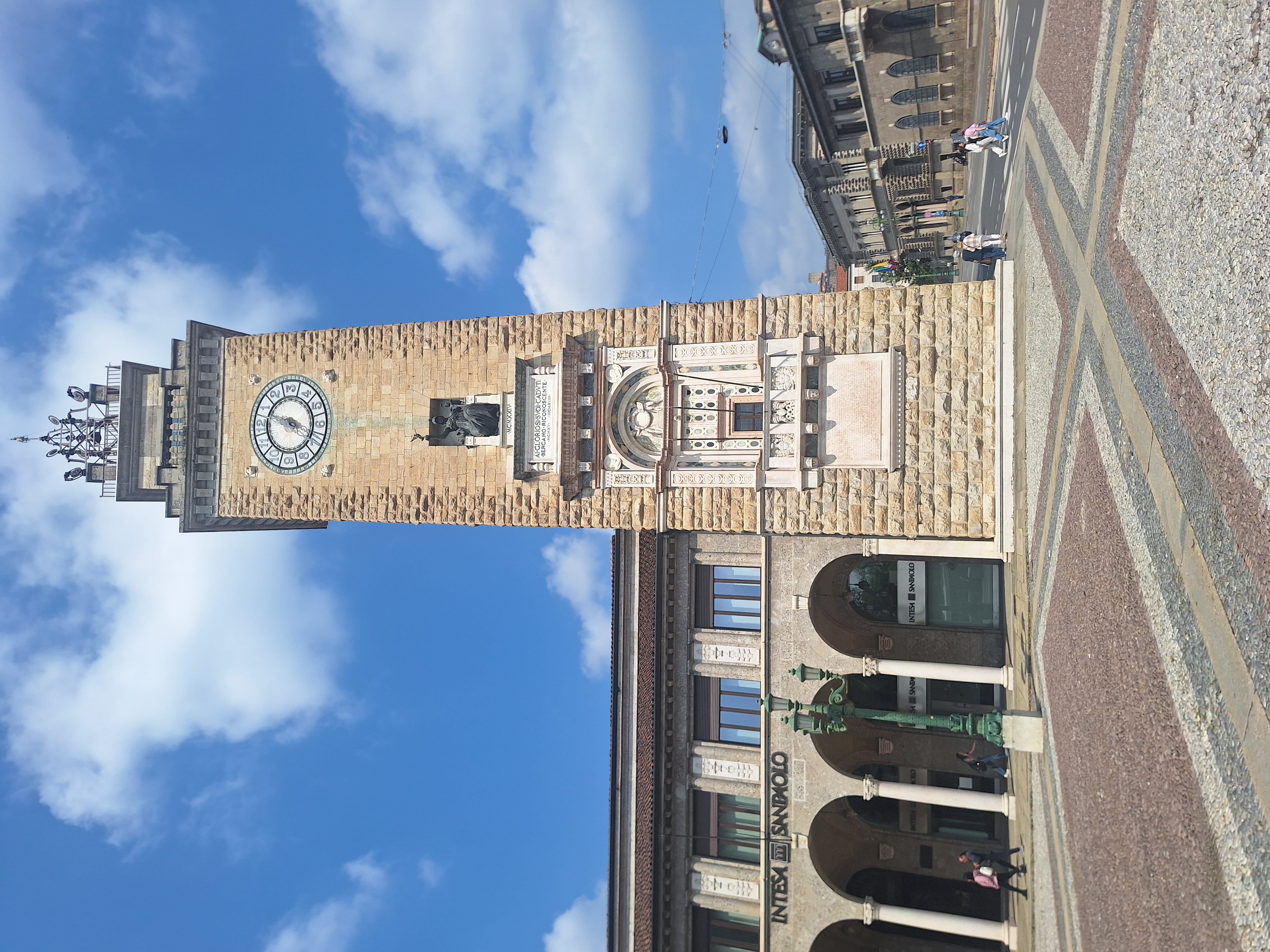
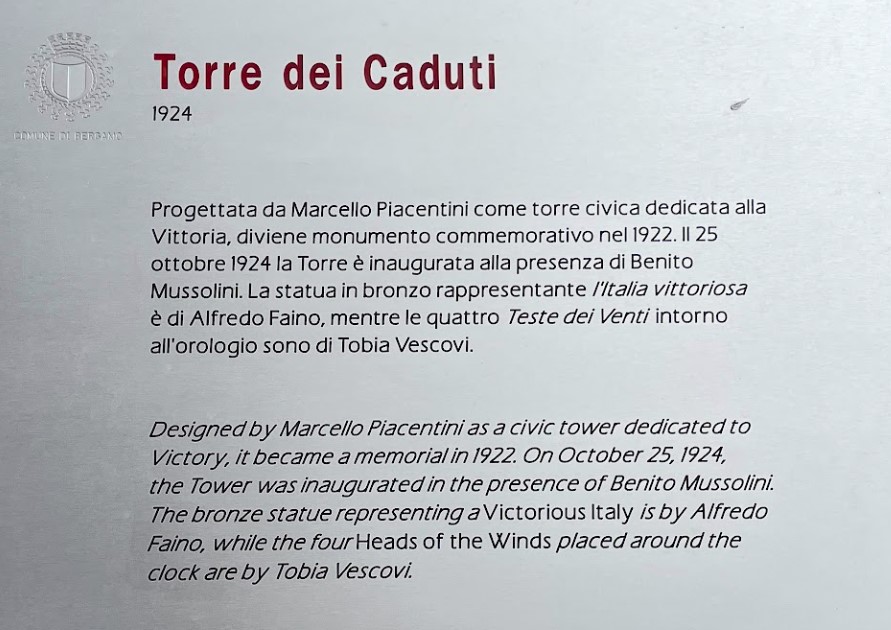
In-depth – "The Chrysanthemum Protest"
On November 4, 1943, a group of women from Bergamo carried out a symbolic act of great courage and protest against the fascist regime. The women – including Adriana De Leidi, Mary Tadini Leidi, Mimma Quarti, Velia Sacchi, Bianca Artifoni, Pina Callegari, Iginia and Emma Coggiola – went beneath the tower in Piazza Vittorio Veneto to lay flowers in memory of those who had fallen in the Great War.
A day that commemorates Italy’s victory in the First World War
The police tried to prevent the laying of flowers by guarding the tower; the women reacted with determination, throwing the flowers over the officers’ heads, thus transforming a commemorative gesture into a public and symbolic act of dissent against the fascist regime.
The following year, the same gesture was repeated thanks to the organization of the Italian Communist Party (PCI), showing how women’s protest in Bergamo had become part of a broader antifascist movement.
To commemorate this important episode, which combines memory of the fallen and civil resistance, Bergamo placed a commemorative plaque inside the tower in Piazza Vittorio Veneto, allowing citizens and visitors to remember the courage of those women who openly challenged fascist authority with a simple yet powerful act.
🎧 Audio Reading
Sources
Bibliographic sources
- Mario Pelliccioli, Memory itineraries. A route in Bergamo through fascism, German occupation and Resistance, Bergamo 2023
- Angelo Bendotti, The conquerors of the empire, Bergamo 2017
- Angelo Del Boca, The Italians in East Africa, vol. III, Bari 1982
Multimedia sources
- Images: Project photographic archive, class 5IG Itis P. Paleocapa