Historical Context
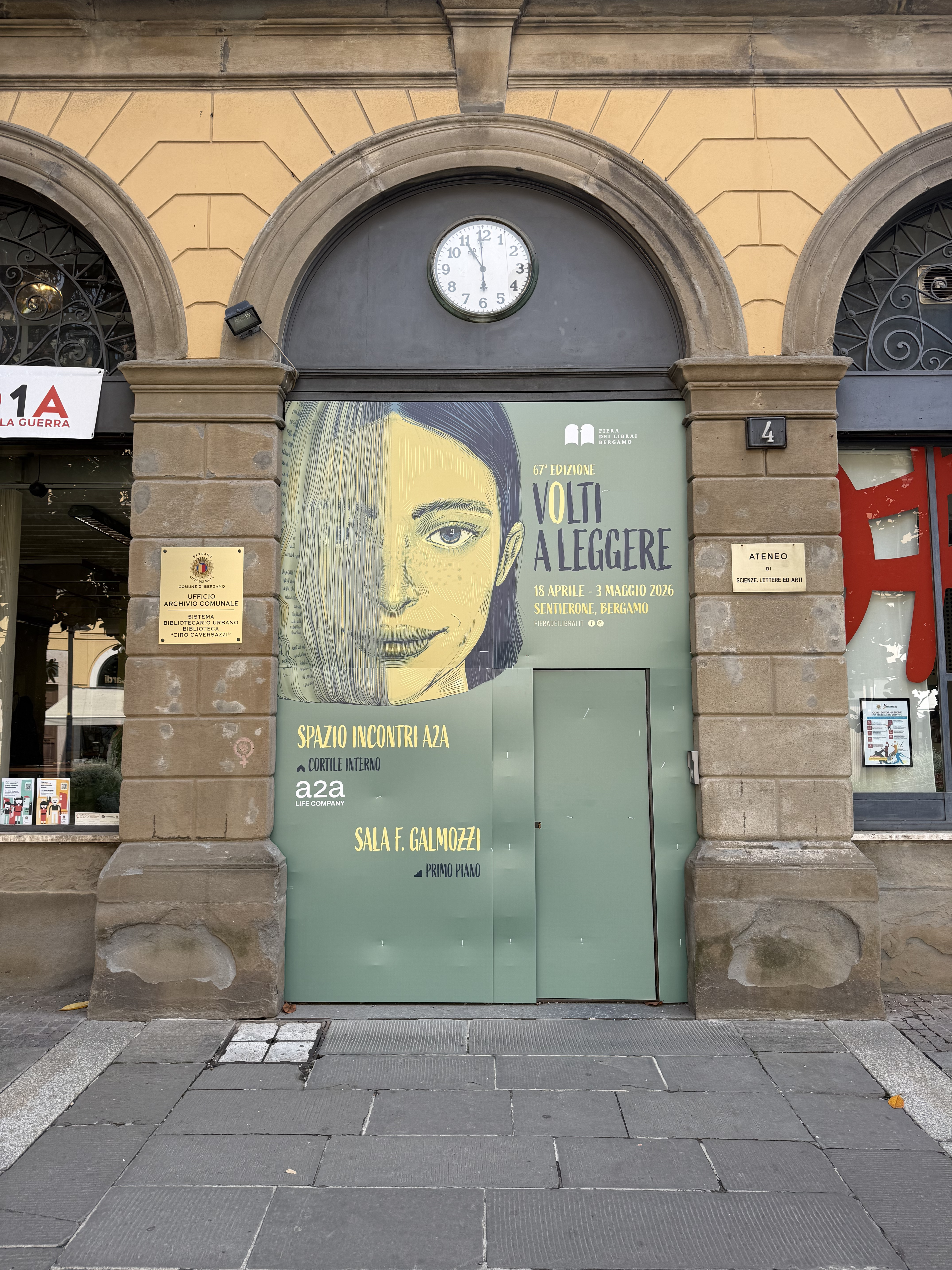
We are at via Torquato Tasso 4, in Bergamo, in a building that today houses the "Ciro Caversazzi" library and other municipal offices. Today it is a public space for study, reading and meeting, but during the crucial years of the war and occupation this place became home to several newspapers that reflected the political changes of the time.
Ciro Caversazzi (1865–1947) was an important figure in Bergamo's cultural life at the turn of the twentieth century: a man of letters, scholar and promoter of civic and cultural initiatives.
According to local archival records and catalogues, from 16 May 1945 he became ordinary commissioner of the Civic Library; he died in Bergamo on 1 May 1947. Naming the library inaugurated in 1948 after him meant linking this place to a civic cultural memory that was close, in time, to the events of the war and the post-war period.
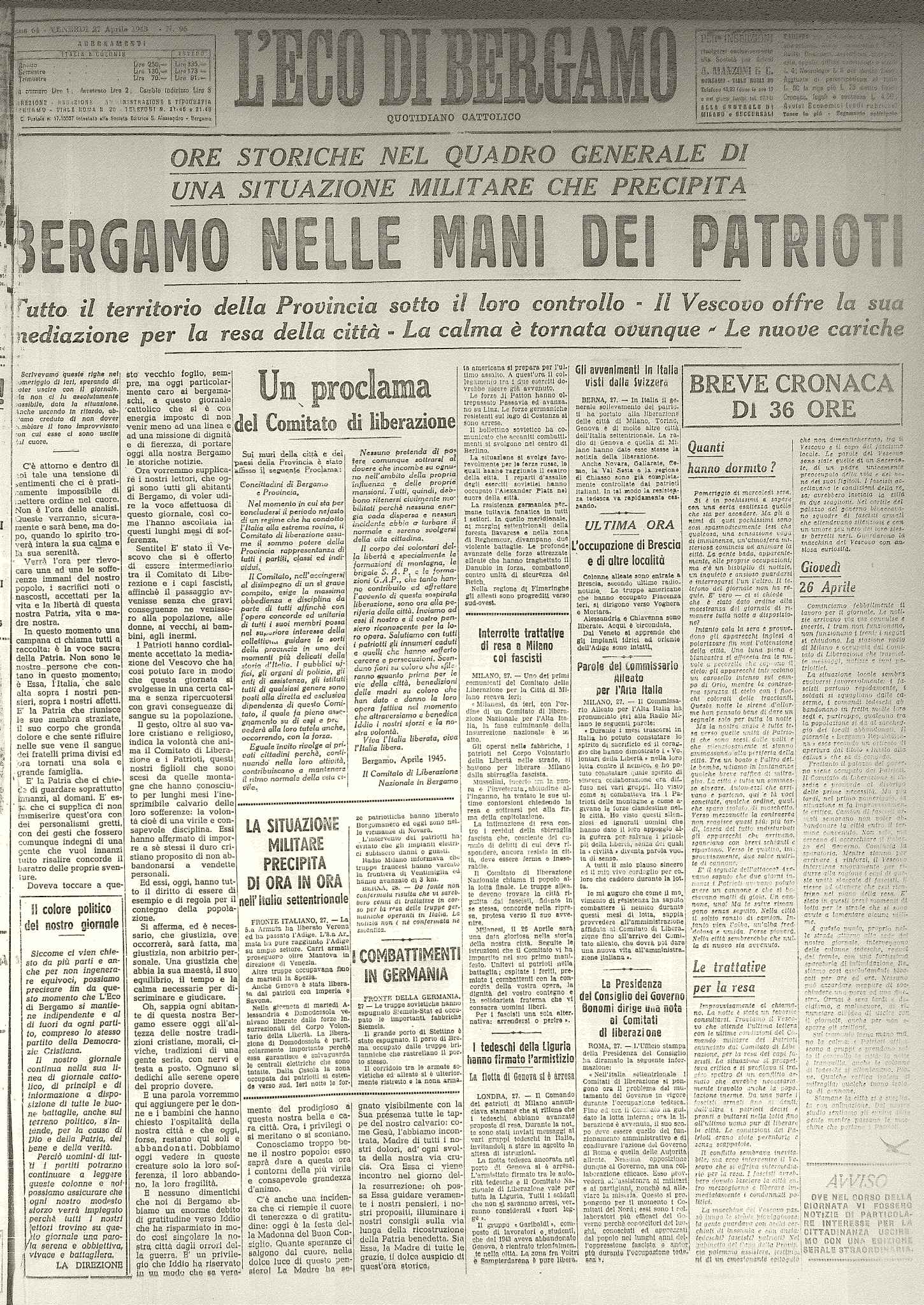
The building, constructed between 1855 and 1858 in neoclassical style, after having served from 1873 as the old Town Hall — where the town council met until 1873, testifying to the building's centrality in the political and civic life of the city from its earliest days — became, from the fall of Fascism on 25 July 1943, the home of several local daily newspapers, which succeeded one another according to events. Initially it housed La Voce di Bergamo, a local Fascist daily, which became the unofficial organ of the provincial CLN under the editorship of Alfonso Vajana. During the German occupation and the RSI, La Voce di Bergamo changed its name and editorial direction to "Bergamo Repubblicana", the newspaper of the Republican Fascist Federation, directed by Arturo Abati. Finally, after the Liberation, the paper adopted the new name "Il giornale del popolo" and was officially the organ of the provincial CLN until 31 July 1946. These successive changes bear witness to the importance of press control, which under Fascism became central and monopolistic (veline), to the point of being managed, together with all other means of communication, by a Ministry created specifically for the purpose.
The most widely read newspapers in Bergamo during Fascism were "La Voce di Bergamo", the local Fascist daily, and "L'Eco di Bergamo", a Catholic paper representing the Bergamo diocese. The latter gradually abandoned its support for the Italian People's Party and its condemnation of Fascism, progressively adopting an attitude of submission to the calls of ecclesiastical authority and the pressures of the local Fascist federation.
After 25 July 1943, "La Voce di Bergamo" was based here; after 8 September 1943, with the German occupation and the Italian Social Republic, the building became the home of "Bergamo Repubblicana"; after the Liberation, the paper adopted the name "Il giornale del popolo" and became the organ of the provincial CLN.
"La Voce di Bergamo":
During the Fascist period it was one of the most widely read newspapers in Bergamo
and was the local Fascist daily.
After 25 July 1943:
While keeping its title, it became the unofficial organ of the CLN
and was edited by Alfonso Vajana.
On 10 September 1943, following the armistice, the paper's management came to an end;
collaborators who were unable to flee faced arrests, convictions and persecution.
Italian Social Republic (RSI):
The Fascist regime established in northern Italy after 8 September 1943,
under German control.
Context:
During this phase, the North experienced German military occupation, repression,
civil war and Resistance.
Relationship with the press:
Information was subjected to strict control and used as an instrument of propaganda,
political legitimisation and the construction of consent.
CLN – National Liberation Committee:
The political body that coordinated anti-Fascist forces during the Resistance.
After the Liberation:
"Il giornale del popolo", edited by Alfonso Vajana, became the organ of the CLN
until 31 July 1946.
Significance:
The transition from a Fascist newspaper to a CLN newspaper shows concretely
how a shift in political power also changes the public voice that narrates reality.
This chapter fits within the broader context of Fascist control of information: the monopoly over the press and the importance attributed to propaganda were typical features of both the Fascist and Nazi dictatorships. The regime progressively built a system of subordination of newspapers to political power, founded on laws, prior censorship and daily directives.
Press Law of 1 January 1926:
It established that no newspaper could be printed without a responsible editor
recognised by the state authority: locally, the Prefect.
Responsibility:
The editor was criminally liable for everything published in the newspaper.
Prior censorship:
A copy of everything printed in typographies (pamphlets, posters, books, newspapers,
magazines, etc.) had to be deposited with the court before distribution, in order to
obtain authorisation for printing and circulation.
Ministry of Popular Culture:
The main instrument of the new policy of press control and propaganda.
Origins:
It grew out of the transformation of the Press Office of the Head of Government
into the Under-Secretariat for Press and Propaganda (September 1933),
subsequently elevated to a full ministry under its new name on 25 July 1935.
Function:
This ministry oversaw propaganda activities in all sectors and the control of
the daily press and the press in general.
Mussolini was well aware of the political value of the press, drawing on his own experience as editor of "Avanti" and "Il Popolo d'Italia", and had in mind a systematic plan for the subordination of newspapers to Fascism.
Once the regime was consolidated, alongside the repression of opponents came the daily alignment of the press with directives issued by government bodies on all matters deemed to be of public interest. In this way, the daily press was gradually bent to the needs of power. The concrete instrument of control was the "veline": directives from the regime written on unsigned, unheaded sheets of tissue paper, addressed to newspaper editors and containing instructions on what to publish and what to omit.
🎧 Audio Reading
Why It Is a Place of Memory
The Ciro Caversazzi Library is a place of memory because it makes visible the relationship between the press, propaganda and power. Here one understands that information is not neutral: it can be a space for debate, but it can also become an instrument of control, censorship and the shaping of public opinion.
Remembering this building also means understanding how Fascism built its dominion not only through the repression of opponents, but also through the disciplining of public communication, the monopoly over news and the systematic use of propaganda.
The significance of the place is further strengthened when one considers its current use: a public space dedicated to reading and knowledge — the very opposite of a press in the service of power. The library thus represents a symbolic transformation: from a place of information control to a place of free access to knowledge.
🎧 Audio Reading
Multimedia Content
In Depth: The Clandestine Press
In the struggle for Liberation, communication had strategic value: to inform meant to break isolation, to make occupation and violence visible, to connect different groups and to build trust. The clandestine press, though produced under extremely difficult conditions, was an essential instrument for telling reality "from below" and countering the version imposed by those in power.
In the case of Bergamo, some accounts recall the circulation of illegal sheets such as "Bergamo proletaria" and "Italiani che si liberano", bearing witness to a concrete need: to create a counter-narrative at the heart of a controlled and militarised city.
Sources from Bergamo show how closely the clandestine press was bound up with networks of people, couriers and daily micro-actions:
- Salvo Parigi worked in the clandestine network of Giustizia e Libertà and was involved in distributing "Italia Libera", the organ of the Action Party; he was arrested by the SS a few days before the insurrection of 25 April 1945.
- In the Turani Band, alongside direct-action operations, there was also propaganda work and the production of informational material; the Nazi-Fascist repression struck the group hard between November 1943 and March 1944.
- The case of Evaristo Locatelli illustrates the risks associated even with distributing clandestine press material: arrest, torture, trial and deportation.
🎧 Audio Reading
Sources
Bibliographic Sources
- Mario Pelliccioli, Itinerari di memoria. Un percorso a Bergamo tra fascismo, occupazione tedesca e Resistenza, Moltefedi Achille Grandi Editore, Bergamo 2023
- Tranfaglia N., Murialdi P., Legnani M., La stampa italiana nell'età fascista, Laterza, Bari-Roma, 1980.
Multimedia Sources
- Image 1: Photographic archive of the project, class 5IG Itis P. Paleocapa
- Image 2: 25 aprile Festa della Liberazione, Biblioteca Civica Angelo Mai, Bergamo, 2021