Historical Context
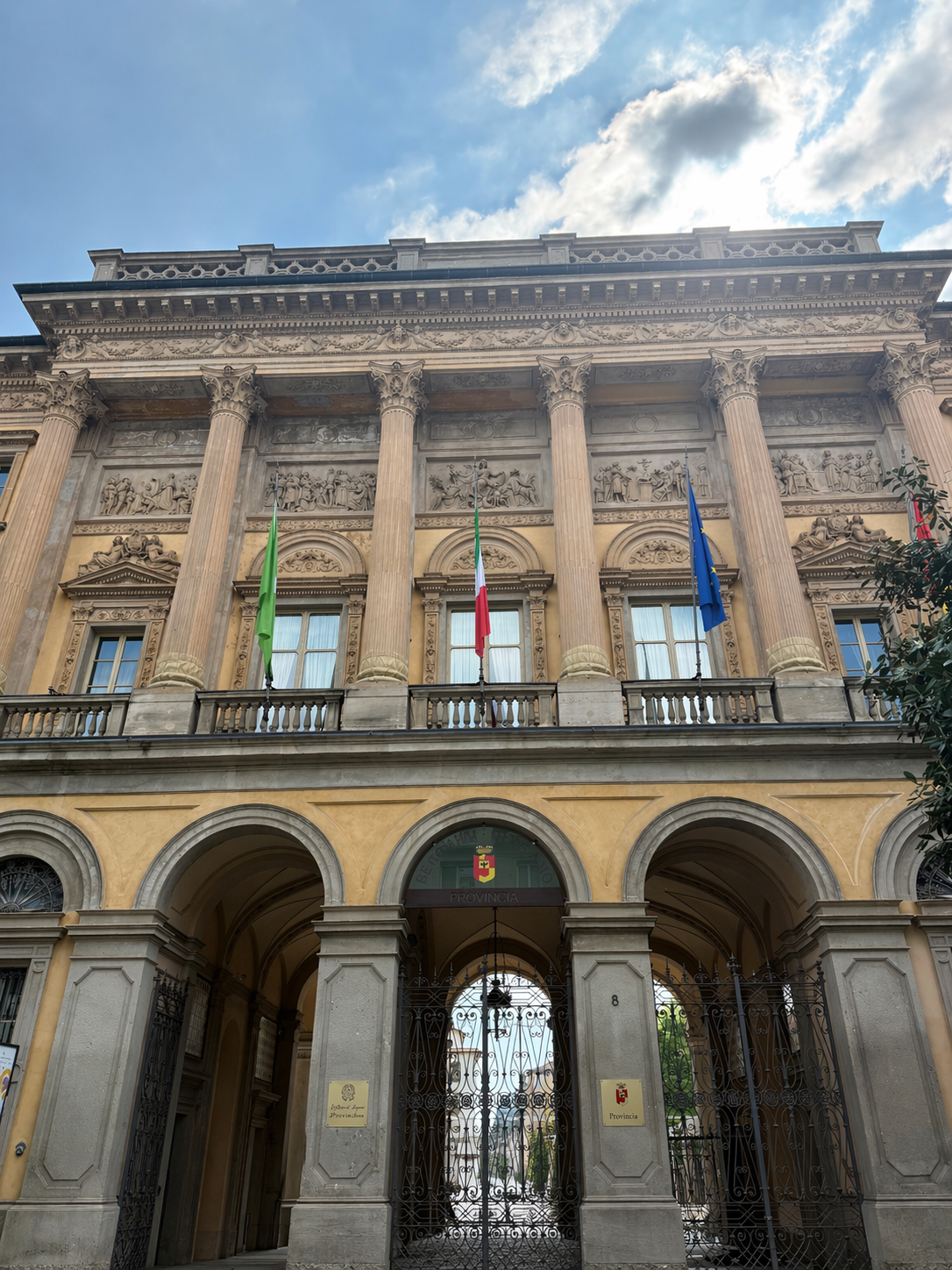
We are standing in front of the Prefecture building, at via Torquato Tasso 8. During the twenty years of Fascist rule, this was the seat of the highest local authority of the State. The Prefect represented the central Government and exercised strong political and administrative control over the territory.
During the Italian Social Republic, the office of Prefect was transformed into that of Head of the Province, further strengthening the repressive role of the regime at the local level.
🎧 Audio Reading
Why It Is a Place of Memory
This building is linked to central moments of the Bergamo Resistance and the Liberation. On 8 September 1943, on the eve of the German occupation, Ettore Tulli organised an action here to recover weapons, giving rise to the first arsenal of the "Pisacane" partisan band.
On 26 April 1945, the Prefecture was the first building to be liberated by the partisans. The National Liberation Committee appointed Ezio Zambianchi as Prefect of the Liberation, marking the transition from Fascist to democratic power.
"The Constitution is not a machine that, once set in motion, runs by itself: every day it needs the commitment and responsibility of its citizens."
Piero Calamandrei🎧 Audio Reading
Multimedia Content
.jpg)
In Depth – Ettore Tulli and the "Carlo Pisacane" Band
Ettore Tulli was one of the central figures of the first armed Resistance in Bergamo following 8 September 1943. Coming from an anti-Fascist family, Tulli developed early on a position of firm opposition to the regime, which led him to become actively involved in the struggle against Fascism and the German occupation.
Immediately after the armistice, Tulli was among the protagonists of the action carried out at the Prefecture of Bergamo, where he attempted to recover weapons to prevent them from falling into the hands of the Germans and the Republican Fascists. From this initiative, one of the city's first partisan arsenals was born — a fundamental element for the launch of organised Resistance.
During the autumn of 1943, Tulli contributed to the formation of the "Carlo Pisacane" partisan band, initially active between Bergamo and the Val Brembana, particularly in the areas of Santa Brigida and Erna. The choice of the name "Pisacane" explicitly evoked the values of the Risorgimento and the sacrifice for freedom, underlining the ideal connection between the partisan struggle and the battles for national unity and independence.
The Pisacane band operated during a still early and difficult phase of the Resistance, characterised by a shortage of weapons, precarious organisation and fierce repression by the Fascist authorities. For this very reason, the role of Tulli and his comrades takes on a particularly significant value: they represented one of the first nuclei of armed opposition in the Bergamo area, anticipating forms of struggle that would go on to take shape in the following months.
🎧 Audio Reading
Sources
Bibliographic Sources
- Mario Pelliccioli, Itinerari di memoria. Un percorso a Bergamo tra fascismo, occupazione tedesca e Resistenza, Moltefedi Achille Grandi Editore, Bergamo 2023
- Giuseppe Gaudenzi, Ettore Tulli e la banda Pisacane, Il filo di Arianna, Bergamo, 2002
- Further reading: La banda Pisacane , Associazione Culturale Banlieue
Multimedia Sources
- Image 1: Photographic archive of the project, class 5IG Itis P. Paleocapa
- Image 2: GI DI ENNE, Authorities on the balcony of the Prefecture, Raccolta Domenico Lucchetti, Fondo famiglia Giovannelli De Noris, Museo delle storie di Bergamo, Archivio fotografico Sestini
- Video: L'Altezza Reale il Duca di Bergamo presenzia l'annuale celebrazione del primo Tricolore Italiano, Archivio Luce Cinecittà