Historical context
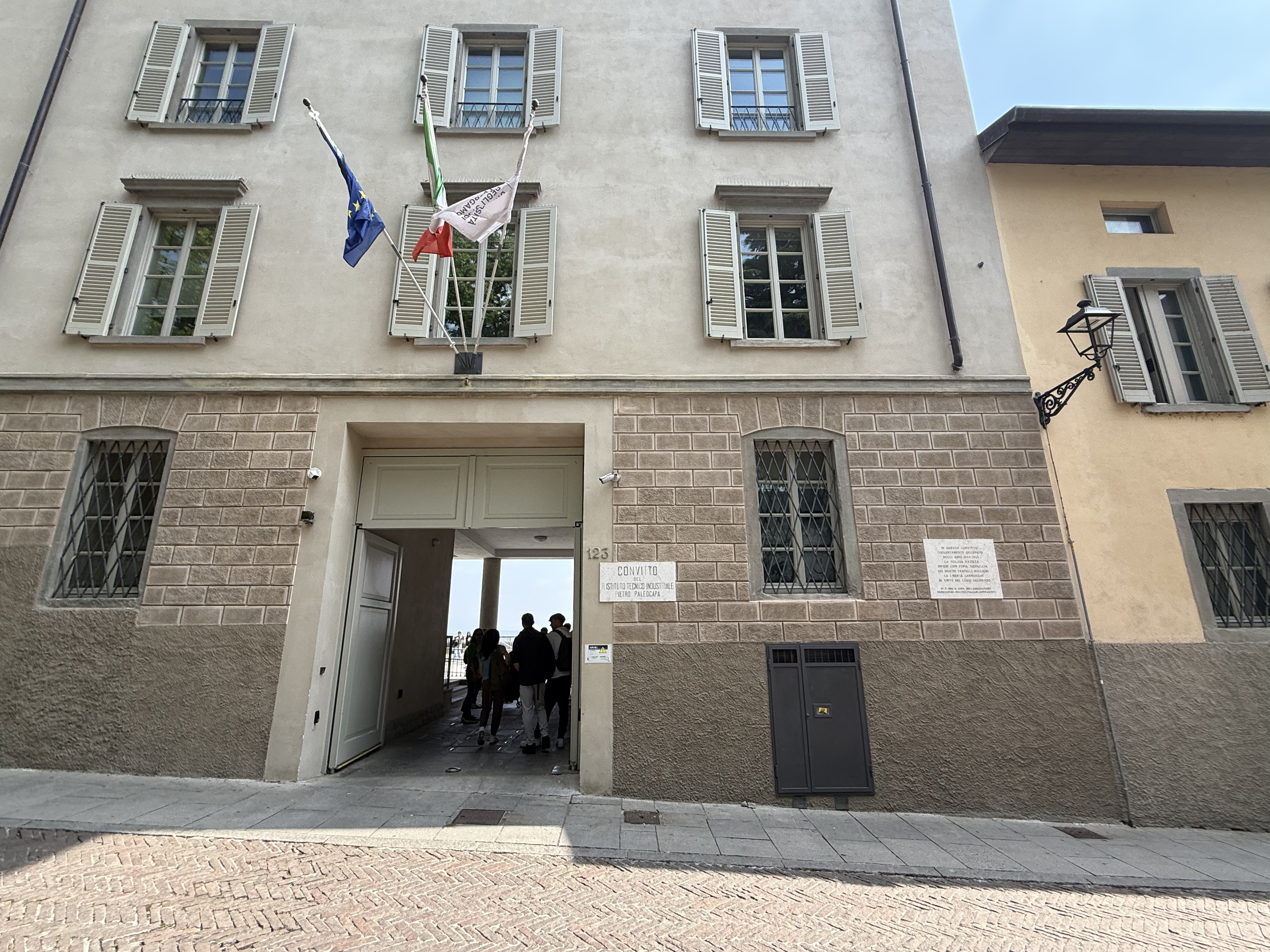
We are in front of Collegio Baroni, located at 123 Via Pignolo, now home to the University of Bergamo. It was founded at the end of the 19th century as an elementary school with a boarding facility, commissioned by Professor Angelo Baroni. It later became a boarding school of the Royal Technical Industrial Institute, hosting students from across the province.
During the German occupation, on October 3, 1943, the building was requisitioned and transformed into the headquarters of the German Gendarmerie Command and a political prison.
🎧 Audio narration
Why it is a place of memory
Between 1943 and 1945, Collegio Baroni was one of the main centers of Nazi repression in Bergamo. Anti-fascists and partisans accused of crimes against German authority were imprisoned and interrogated here, before being transferred to the Sant’Agata prison or to the Matris Domini monastery.
Numerous testimonies describe extremely harsh interrogations and inhumane torture. Don Mario Benigni endured violence for days, while other prisoners were brutally killed. This building stands as a symbol of the violence of Nazi occupation and the sacrifice of those who fought for freedom.
🎧 Audio narration
Multimedia content
.jpg)
In-depth: Prisoner transfers and testimonies
According to several testimonies, in January 1944 the SS guards stationed at Collegio Baroni were recalled to the front, and the building was emptied of prisoners on the night of the 21st. At least five witnesses – Franco Maj, Cesare Bonino, Giovan Battista Cortinovis, Luigi Mondini, Giacomo Paganoni – recount that night.
According to Cesare Bonino, a total of 56 prisoners, guarded by about ten SS soldiers, were brought into the courtyard under the watch of their worried captors, as Cortinovis notes, and then transferred to the Sant’Agata prison, where a German garrison had been established since December 1943.
This was not a definitive closure of the Baroni: as late as March 1944, captured partisans, such as Adriana Locatelli and some of her companions from the Maresana group, were still brought there. Most likely, the reduced German staff was supported by fascist personnel.
Cross-referencing testimonies reveals an increasingly efficient organization of the fascist repressive apparatus, in which figures such as Resmini, Strohmenger, Monge, Ghisleni, Zanchi, Messaggi worked in full coordination with the Nazi authorities.
🎧 Audio narration
🎧 Audio testimony – Interview with Franco Mai
Original recording in which Franco Mai recounts the interrogation phases endured by prisoners.
🎧 Audio testimony – Diary of a partisan woman
Excerpt from a partisan woman’s diary describing the abuse and torture suffered during detention.
Sources
Bibliographic sources
- Mario Pelliccioli, Itinerari di memoria. Un percorso a Bergamo tra fascismo, occupazione tedesca e Resistenza, 2023
- Giacinto Gambirasio, In collegio, in Due mesi di carcere, 1964
Multimedia sources
- Franco Mai interview – ISREC Bergamo
- Diary of a partisan – ISREC Bergamo
- Project photo archive