Historical Context
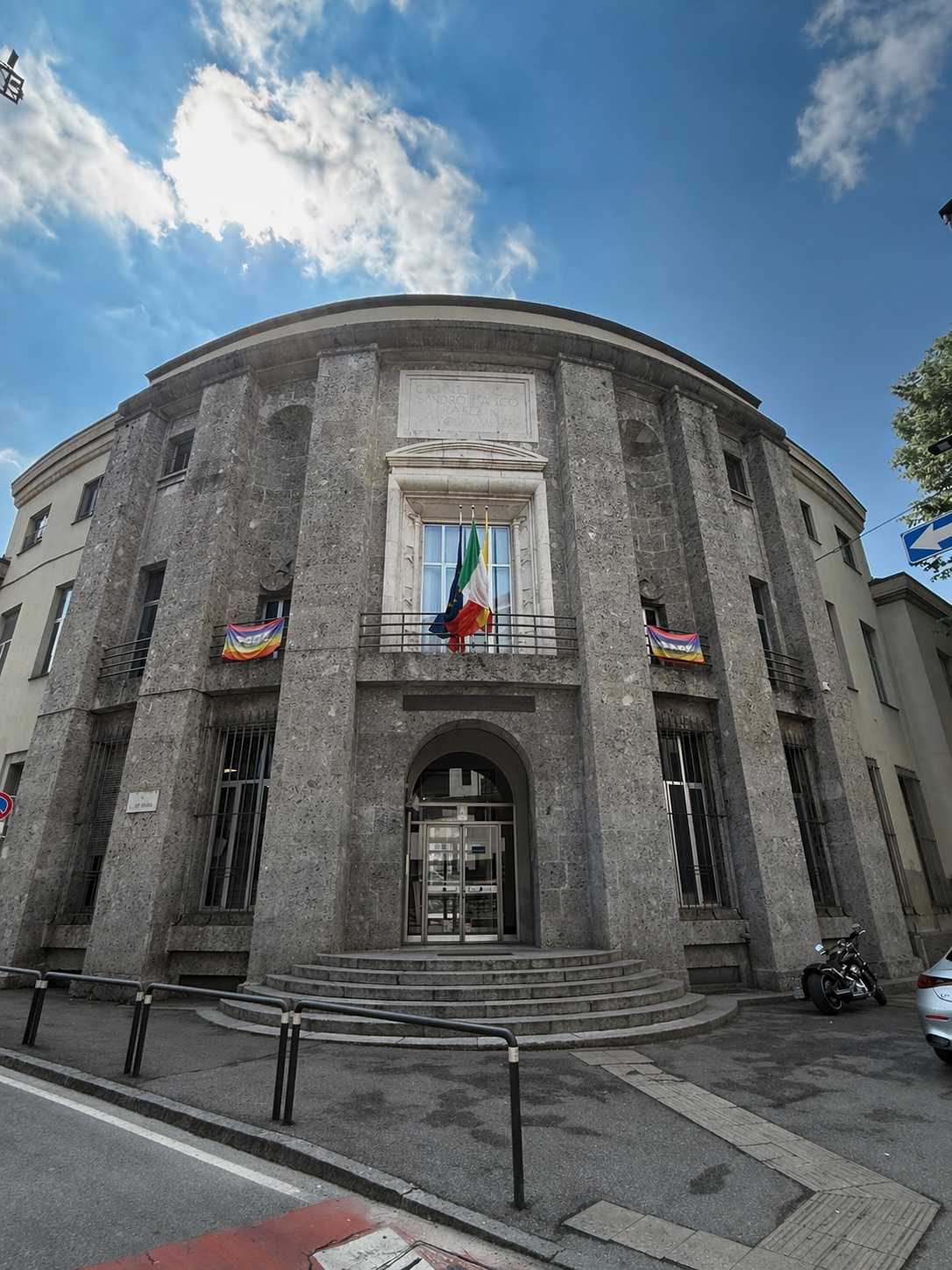
We are standing in front of the "Filippo Lussana" State Scientific High School, an institution that has lived through several historical phases, each of which has left its mark on the place and its identity.
The building that today houses the high school was designed by Alziro Bergonzo (1906–1997) — a representative of rationalism and a figure associated with Fascist architecture in Bergamo — and was commissioned to serve as the headquarters of the Opera Nazionale Balilla (ONB). It was inaugurated on 22 June 1932. During the 1930s it became the headquarters of the Gioventù Italiana del Littorio (GIL).
On the façade there is still a large memorial plaque dedicated to Sandro Italico Mussolini; in the central part of the building, Fascist symbols in relief are also still visible.
Sandro Italico Mussolini was a nephew of Benito Mussolini. He died at the age of twenty from leukaemia. The dedication on the building's façade bears witness to the strong symbolic and political value attributed to this place by the Fascist regime.
During the German occupation, between 1943 and 1945, the building became the headquarters of the avanguardisti moschettieri — young people between 15 and 18 years old enrolled in the National Republican Guard. Despite their very young age, they were also deployed in anti-partisan activities.
The basement rooms still preserve writings that recall the different uses of that period: first changing rooms, then a place of detention and torture, then a storage facility.
After the war, the building became the home of the "Paolina Secco Suardo" Teacher Training Institute, and from 1968 of the "Filippo Lussana" State Scientific High School.
The Gentile Reform, named after Education Minister Giovanni Gentile, came into force in 1923, shortly after the March on Rome. It represents a centralist and selective vision of education, at the top of which stand the licei — classical above all — destined to train the ruling classes and cultural élites. Clearly distinct from these was technical and vocational education, intended for the subordinate classes. Compulsory religious teaching in primary schools was also introduced.
🎧 Audio Reading
Why It Is a Place of Memory
This building is a public school today, yet it still preserves clear traces of its past. Repurposing a building like this one — originally built for the ideological regimentation of young people — is a meaningful choice.
Walking through these spaces means confronting a complex memory: that of a place born for the ideological indoctrination of youth and later transformed into a seat of republican education. Its history invites reflection on how education can be used both to emancipate and to subjugate. We must not forget that even before the creation of the Opera Nazionale Balilla, control over young people was pursued through the Gentile Reform of 1923.
🎧 Audio Reading
Multimedia Content
.jpg)
In Depth: ONB, GIL and the Control of Youth
The Opera Nazionale Balilla (ONB) and, later, the Gioventù Italiana del Littorio (GIL) were fundamental instruments of the Fascist educational project. These organisations worked alongside the school and aimed at the physical, moral and political education of young people.
All young people between the ages of 6 and 18 were enrolled in organisations differentiated by age and gender.
For boys:
- Figli della lupa (Sons of the She-Wolf), ages 6–8
- Balilla, ages 8–14
- Avanguardisti, ages 14–18
For girls:
- Figlie della lupa (Daughters of the She-Wolf), ages 6–8
- Piccole italiane (Little Italian Girls), ages 8–14
- Giovani italiane (Young Italian Women), ages 16–18
For boys, activities were largely preparatory to military service; for girls, the regime provided activities linked to parades and public events, in keeping with the traditional female model imposed by Fascism.
All participants took part in the sabato fascista (Fascist Saturday), which included lessons in Fascist doctrine and gymnastic activities. The regime's control, however, was not limited to school: it also encompassed leisure time, so as to occupy the entire lives of young people.
This system also included other organisations and leisure activities, designed to extend the regime's control beyond the school environment.
Fascist control over youth and society extended beyond the school through:
- Gruppi Universitari Fascisti (GUF) for university students
- Summer colonies, organised along military lines
- Dopolavoro Nazionale, offering leisure and recreational activities for workers
In this way, the distinction between school, leisure time and private life tended to disappear.
In 1939, pre-military service was also introduced, further strengthening the military preparation of young people.
In 1939, pre-military service for young people began, with the obligation to report every Saturday afternoon to their respective neighbourhood groups. This step makes it explicitly clear how Fascist education was closely linked to the militarisation of youth.
The Fascist educational project soon came into conflict with the Catholic Church, which had its own network of youth associations. In 1928 the regime dissolved non-Fascist youth organisations, including the Scout associations; from the early 1930s the only association still active was Azione Cattolica, which however had to limit its activities strictly to the catechetical sphere.
Azione Cattolica Italiana (Catholic Action) was the only organisation permitted to operate during Fascism, by virtue of the Lateran Pacts. During the Fascist period it remained formally active, but its presence in the educational and youth sphere was severely restricted: the regime allowed it to operate only in the religious and catechetical domain, so as to prevent any competitors in the control of youth formation.
Overall, the Fascist educational project did not aim to form citizens capable of personal choices and aware of their rights and duties, but to create a "Fascist": disciplined, obedient, physically strong, and loyal to the fatherland and the family according to the regime's rhetoric.
🎧 Audio Reading
Sources
Bibliographic Sources
- Mario Pelliccioli, Itinerari di memoria: un percorso a Bergamo tra fascismo, occupazione tedesca e Resistenza, i Libri di Moltefedi, Bergamo 2023.
- Guya Bertelli, Manuela Brambilla, Matteo Invernizzi, Bergamo: cent'anni di architettura 1890-1990, Alcon, Bergamo 1994.
Multimedia Sources
- Image 1: Photographic archive of the project, class 5IG Itis P. Paleocapa
- Image 2: Pietro Gentili, Bergamo edificio in costruzione, Fondo Pietro e Achille Gentili, Museo delle storie di Bergamo, Archivio fotografico Sestini